
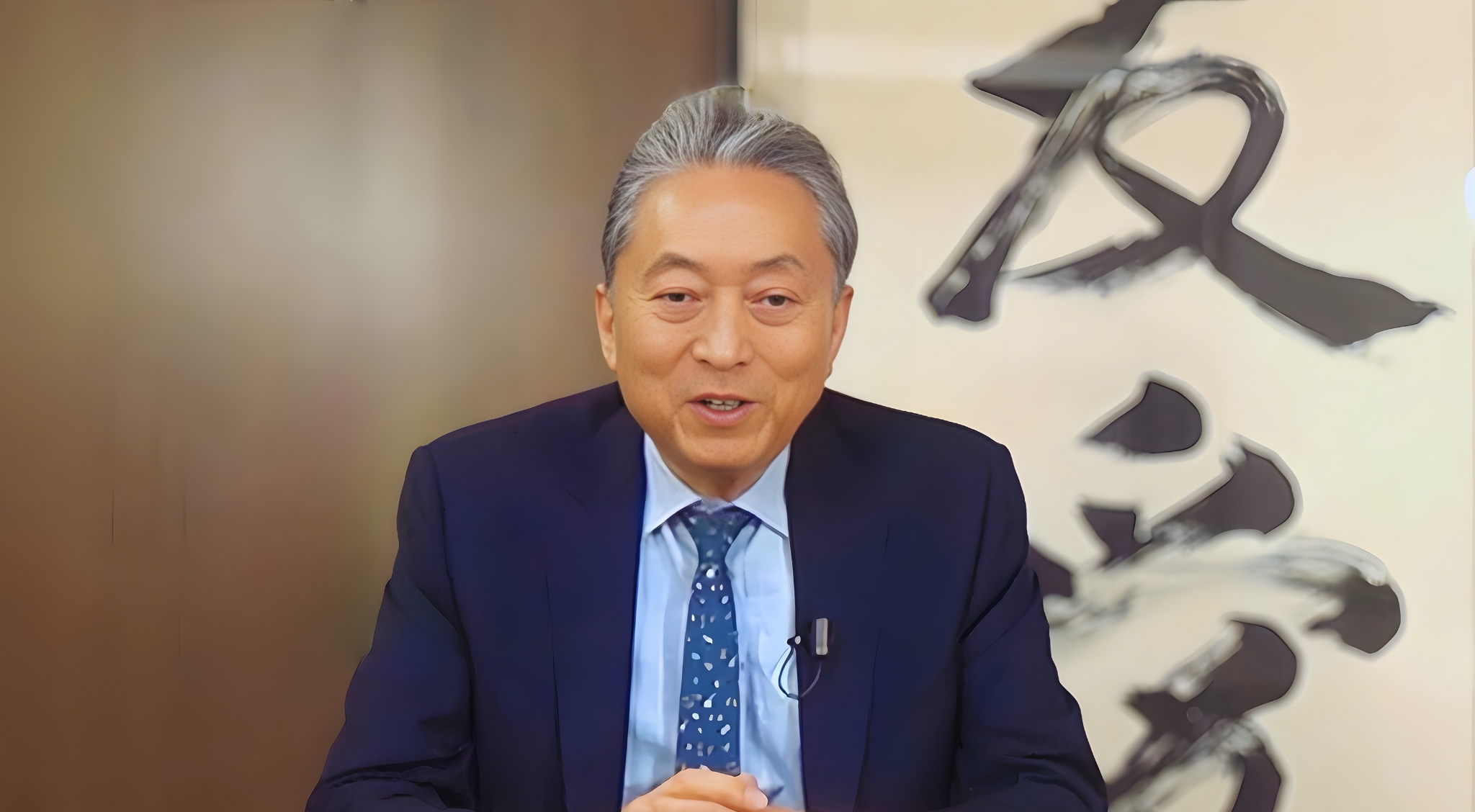
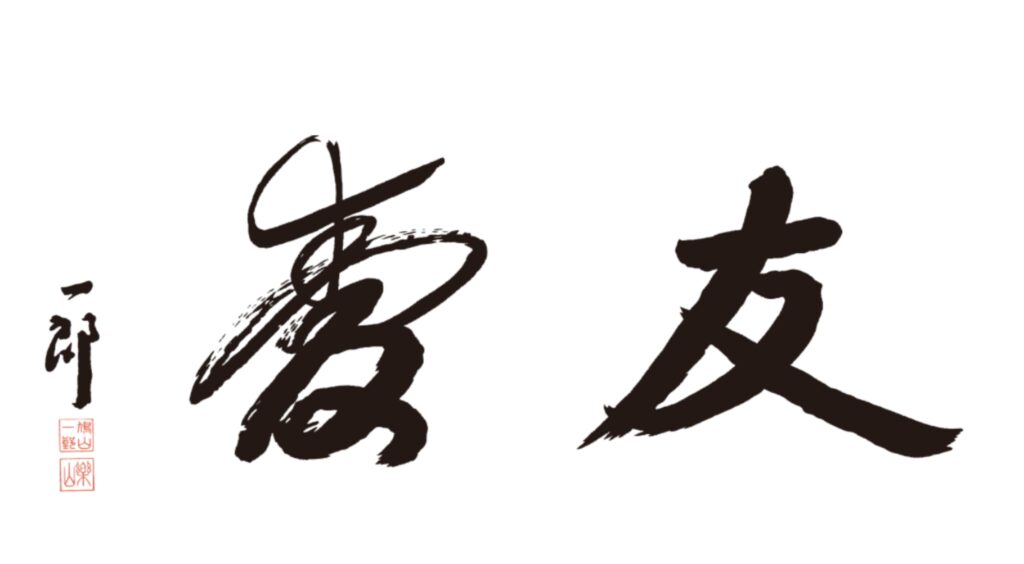
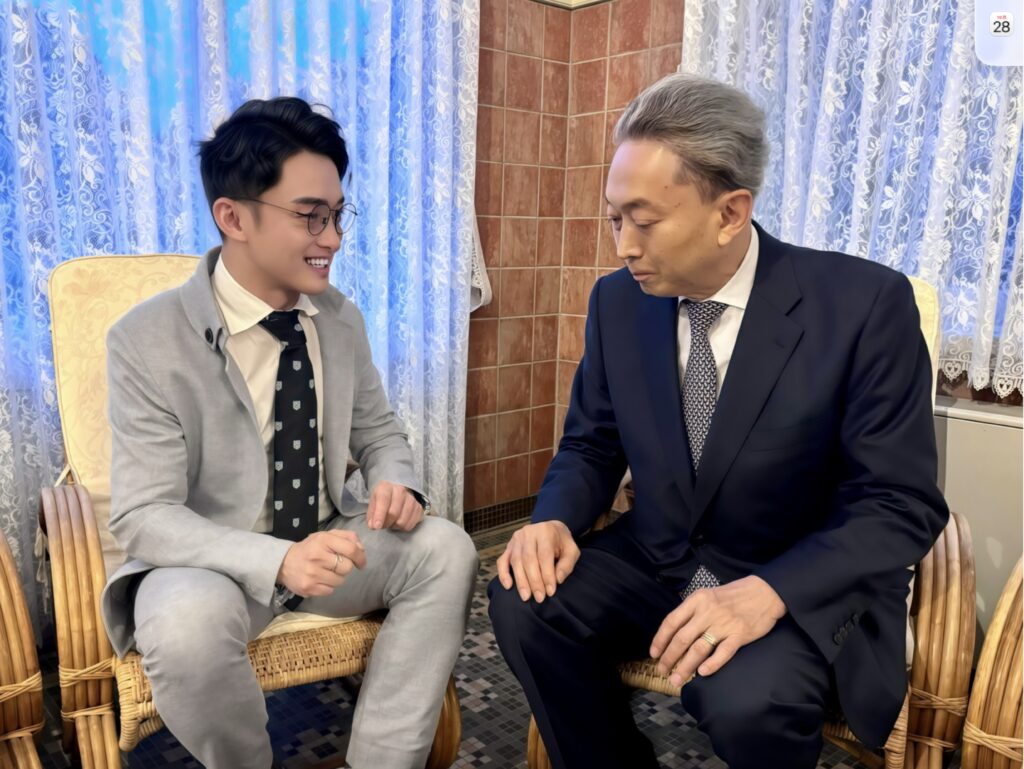
It was a quiet afternoon in Tokyo. The rain had just cleared, and winter sunlight filtered softly through the trees of the Bunkyō ward, into a serene residence in the neighbourhood of Otowa. Inside, shelves were lined with philosophical classics from East and West, volumes on global politics, and gifts from around the world. At a desk sat former Prime Minister Yukio Hatoyama, calmly holding a piece of calligraphy bearing two characters: 「友愛」 (Yuai, or “fraternity”). He turned to The Icons interview team and said:
“We’ve grown too used to organising the world through competition — and forgotten that humanity’s greatness has always been rooted in mutual understanding and respect.”
This is not a statesman who chose silence after office. Hatoyama has taken a far more demanding path: rather than retreat from public life, he stepped into a deeper, long-term challenge — one grounded not in electoral cycles or power structures, but in values, systems, and the moral direction of civilisation itself.
No longer relying on laws or mandates, he writes with thought and acts with intention, working to shape a development model that is softer, more humane — one with a soul.
This long-term experiment has also been embodied in the Public Interest Incorporated Foundation Yuai — an international platform founded and led by him, carrying forward a belief sustained across three generations while addressing the challenges of the present age. It is not a mere continuation of the past, but a deliberate attempt to turn an ideal into tangible reality.
Beyond Politics: A Civilisational Mission Still Unfinished
Hatoyama was one of the founding figures of the Democratic Party of Japan and once led a government navigating one of Asia’s most structurally complex democracies. But for him, the role of Prime Minister was never the destination — it was the beginning of something more transformative.
“I entered politics to change the system; I left politics because I realised the greater need was for those who could transform our thinking.”
He said this without drama — yet the words carried weight, as if pulled from history itself.
For Hatoyama, real change was never about authority. It was always about shifting our values — and, ultimately, how we understand civilisation. Over time, he came to see that the crises of our world were not only economic or geopolitical in nature, but rooted in something more fundamental: by what standard do we measure prosperity and progress?
His answer is Yuai. A term embedded in his family legacy since the days of his grandfather, Prime Minister Ichirō Hatoyama, Yuai has now been redefined by Yukio as a cornerstone for a new civilisational narrative.
He insists this is not naïve idealism. It is the result of decades observing the machinery of international politics — and realising that while systems may be replaced, civilisations stagnate when their core values remain unchallenged. Yuai, as a language that crosses cultural and institutional boundaries, is not merely a national ethic. It is a global negotiation — a collective effort to recognise, respect, and uplift one another.
“Democracy without a soul is just surface form. And development without ethics only accelerates exhaustion,” he says.
“A new civilisation isn’t built through layers of technology — it begins with rewriting the values underneath.”
Yukio Hatoyama may no longer be the one navigating party alliances or steering policy debates. But he remains, unmistakably, a man writing the future at the edges of history. His mission is not to return to power, but to craft a new beginning — one that reminds humanity of the deeper meaning of coexistence.
The Yuai Foundation: A Living Laboratory for Institutionalised Ideals
The origins of the Yuai Foundation date back to 1948, when Yukio Hatoyama’s grandfather, former Japanese Prime Minister Ichirō Hatoyama, founded the Yuai Youth Fellowship. At a time when Japan was emerging from the devastation of war—its society divided and its values adrift—this organisation arose against the current. It was one of the few youth movements grounded in value-centrism, advocating mutual respect, peaceful coexistence, and a profound sense of responsibility for the future.
More than seventy years on, Yukio Hatoyama has reinterpreted this post-war humanist vision as a forward-looking experimental platform — the Yuai Public Interest Foundation. While its institutional form has evolved, its founding conviction remains intact: to rebuild trust, resonance, and systemic goodwill in a fragmented world.
Today, Yuai is far more than an organisation for international exchanges or philosophical declarations. It has matured into a modern structure with global connectivity, cultural reach, and policy influence — pioneering a model of “value-based governance innovation” across Asia and, increasingly, throughout the Global South.
The foundation has also developed a Value-Driven Social Model: from essay competitions for secondary and university students that cultivate critical and civic thinking; to social innovation projects co-designed with local governments; to cross-border youth exchange and cultural missions — each initiative is an exercise in translating a development philosophy anchored in human dignity into tangible practice.
Here, dignity is not left to float as moral abstraction. Instead, it is operationalised as a public grammar — made concrete through principles such as the recognition of difference, guaranteed participation for the marginalised, and an ethical response to the rights of nature and non-human life.
“The greatest challenge is not technical,” says Hatoyama, “but generational: we need to nurture young minds with cultural empathy, a capacity for dialogue, and the ability to think through values. Systems can be exported — but values must be internalised. What we aim to cultivate is a generation that can articulate a new language for the world.”
In a time of volatility, polarisation, and accelerating complexity, the Yuai Foundation operates with a deliberate, unhurried tempo. It does not chase quick political wins or media headlines. Instead, it invests in the slow, deep logic of value, and seeks to rewire governance from within.
“Only institutions built upon values,” Hatoyama affirms, “can truly sustain the diversity and peace the future demands.”
A Village-Scale Value Experiment: Healing the Rift Between Development and Nature with Bamboo
When asked by The Icons team about the Foundation’s most groundbreaking project to date, Hatoyama simply smiled and said:
“Let me tell you a story about bamboo.”
The story begins in Yucun, a once-devastated village in China’s Anji County. For years, it bore the scars of heavy limestone mining — a symbol of environmental degradation in pursuit of growth. But over the past two decades, Yucun has undergone a profound transformation: through ecological rehabilitation and a shift in local values, it has re-emerged as a national emblem of China’s ecological civilisation.
Today, the Yuai Foundation is building on that legacy — not as a nostalgic case study, but as a launchpad for forward-looking action. Yucun now serves as the core site for the Foundation’s flagship project: Bamboo Nexus.
This is not simply a story of local governance success — it is, more crucially, a narrative reversal. With Bamboo Nexus, so-called “developing” or “extracted” regions are repositioned as generators of value. The old industrial development model — reliant on extraction and acceleration — is being supplanted by one that honours ecological rhythm and human context.
As Hatoyama puts it, the point is not to replicate governance miracles, but to reframe the very definition of development — to transform place-based experience into a new development grammar, where culture and ecology are seen not as constraints, but as assets of productivity and meaning.“Yucun’s transformation is not just the story of a village,” Hatoyama reflects.
“It is proof that civilisations can heal themselves — if only we are willing to listen to the language of the land. Nature, in return, will answer with abundance.”

From the SDGs to an Asian Trajectory: A Prototype for Civilisational Transition
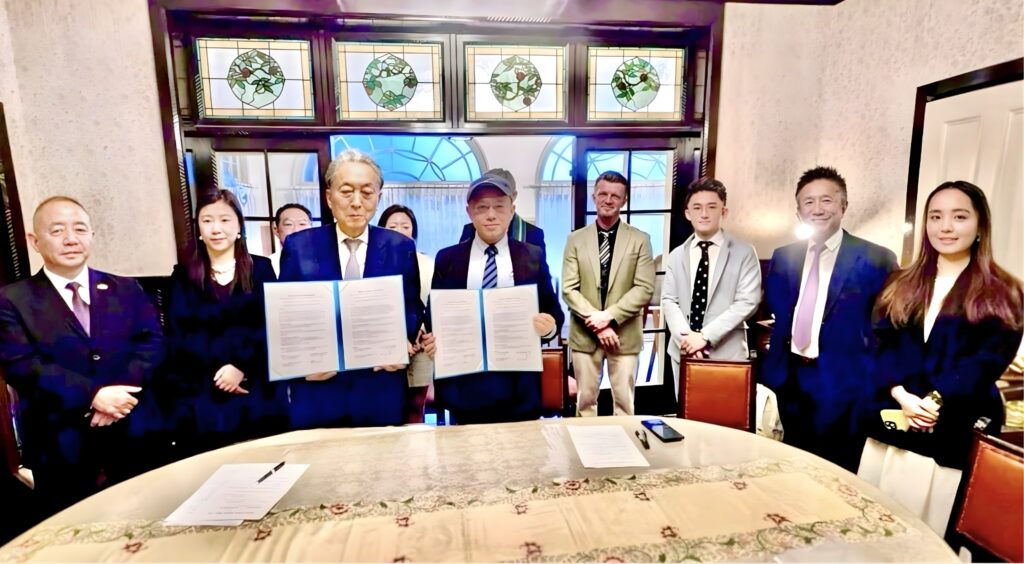
On the afternoon of 22 October 2025, Yukio Hatoyama, Chairman of the East Asian Community Institute, and Mr Zhuang Ning, President of the Yuai World Foundation, jointly signed a cooperation agreement at the Hatoyama Hall in Tokyo. The agreement affirms both parties’ support for the United Nations–endorsed “Bamboo Nexus” initiative and their shared commitment to advancing international exchange. The ceremony, conducted with solemn dignity, marked the formal establishment of a partnership between two organisations of historical heritage and global influence, united in their mission to promote the “Bamboo over Plastic” environmental movement and cross-border collaboration.
“Bamboo, as a fast-growing, renewable and naturally biodegradable material, holds immense potential to replace plastic products,” said Mr Hatoyama. “Its use not only helps to reduce the global issue of ‘white pollution’, but also contributes to the sustainable growth of the green economy — particularly in regions rich in natural resources yet underdeveloped in industrial capacity — by creating employment and delivering ecological benefits.”
He went on to cite the example of Anji County in China, known as the “Hometown of Bamboo”, where the expansion of bamboo processing and product innovation has significantly reduced plastic consumption while increasing farmers’ incomes and upgrading local industries — a model now regarded as a global benchmark for sustainable development.
The Bamboo Nexus initiative is now open to enterprises and individuals who embrace sustainable development and support the value of Yuai. Through diverse forms of collaboration and sponsorship, like-minded partners are invited to contribute towards a more inclusive and regenerative future.
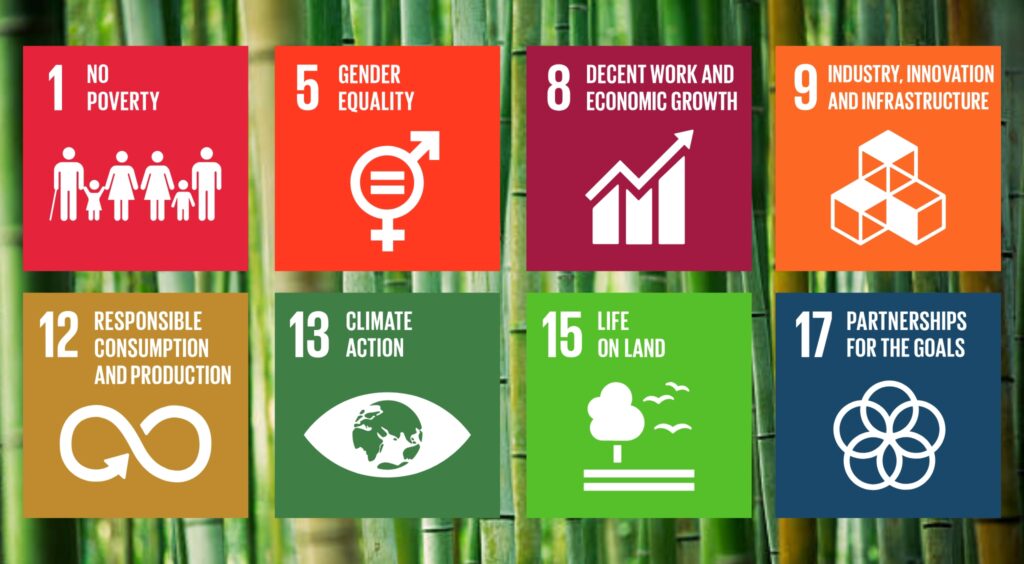
In concrete terms, the Bamboo Nexus project is anchored around four core strategies:
- Inclusive Eco-Economy: Across more than 10,000 hectares of bamboo forests, the initiative supports youth entrepreneurship and gender-inclusive employment. By empowering women, young people, and individuals with disabilities to participate in ecological enterprise, it responds directly to SDG 1 (No Poverty), SDG 5 (Gender Equality), and SDG 8 (Decent Work and Economic Growth).
- Nature-Based Climate Solutions: By enhancing carbon sequestration and restoring biodiversity, the project transforms nature-positive solutions into viable income models through carbon trading schemes, aligning with SDG 13 (Climate Action) and SDG 15 (Life on Land).
- Bamboo-Based Industrial Innovation: Through research and development of bamboo-derived biomaterials, the project seeks to substitute plastics and fossil-based inputs with low-carbon, high-value alternatives. This supports SDG 9 (Industry, Innovation and Infrastructure) and SDG 12 (Responsible Consumption and Production).
- Global Governance via Local Roots: A scalable governance framework for the bamboo economy is under development, setting industry standards from the village to the global stage — a policy model that advances SDG 17 (Partnerships for the Goals).
“This is more than a cross-cultural initiative — it’s a symbol,” says Hatoyama.
“Bamboo is not merely a resource. It is a language of civilisation.”
For Hatoyama, Anji and Yucun are more than geographic markers — they are origin points at the edge of a new epoch. The Bamboo Nexus does not seek to replicate local governance models wholesale, but to use bamboo as a cultural and ecological vector for a broader transformation — a green civilisational wave rooted in local wisdom yet resonating with universal values across Asia and the Global South.
At the core of this wave lies the very principle that defines Hatoyama’s lifelong pursuit: Yuai — fraternity.
From Political Leader to Civilisational Architect
Since stepping away from electoral politics, Yukio Hatoyama has turned his focus to more grounded forms of public engagement — championing institutional and normative innovation outside the formal apparatus of power.
In Japan, he has reintroduced the concept of the living community (or “seimei kyōdōtai”) as a civic ethic, informing national discourses on governance, science, and sustainability. Across Asia, he works closely with local governments and young leaders to co-develop culturally rooted models of sustainable development. Globally, he continues to advocate for a shared language of coexistence — one that transcends the divisions of nation-states and civilisational hierarchies, and reinstates mutual understanding and cooperation as the bedrock of global order.
These efforts may not dominate headlines, nor resemble the dramatic gestures of statecraft. Yet they are quietly reshaping the ethical landscape for generations to come — laying the groundwork for a different way of seeing, and governing, the world.
“The more fragmented the world becomes,” Hatoyama reflects, “the more we must be like bamboo — resilient, flexible, and quietly connecting us all.”
As the interview draws to a close, he turns to The Icons team with a final remark:
“What your publication stands for — leadership and sustainability — deeply aligns with the spirit of the Yuai Foundation.”
Throughout the conversation, Hatoyama’s tone remains calm and measured. But his gaze, unmistakably, is fixed far ahead — attentive not to what is loudest today, but to what will shape the moral architecture of tomorrow.
Recommend for you:
UK Prime Minister Keir Starmer: Rebuilding Britain’s Future Through Responsible AI Sovereignty







-1-scaled-e1698983370831-120x86.jpg)