
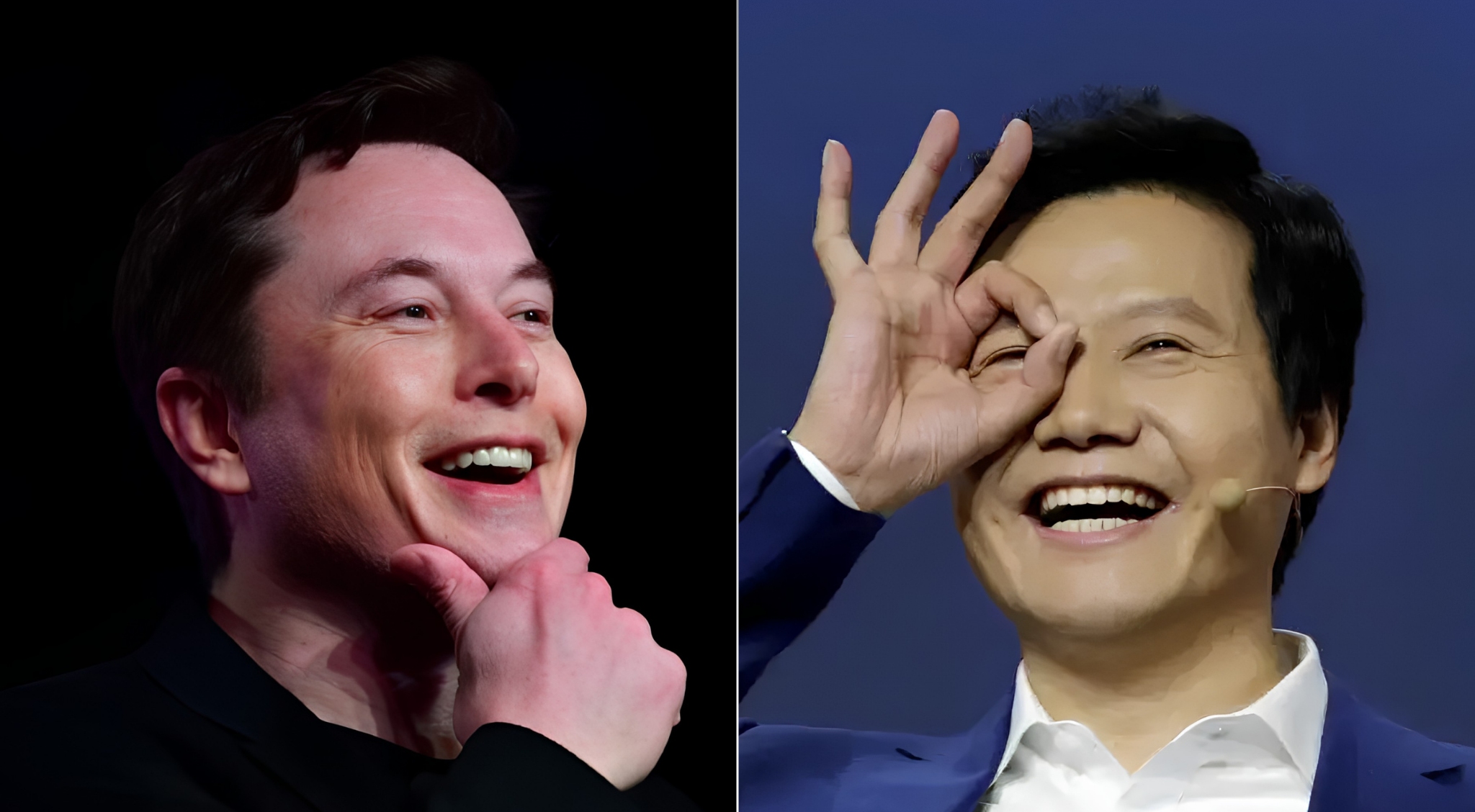
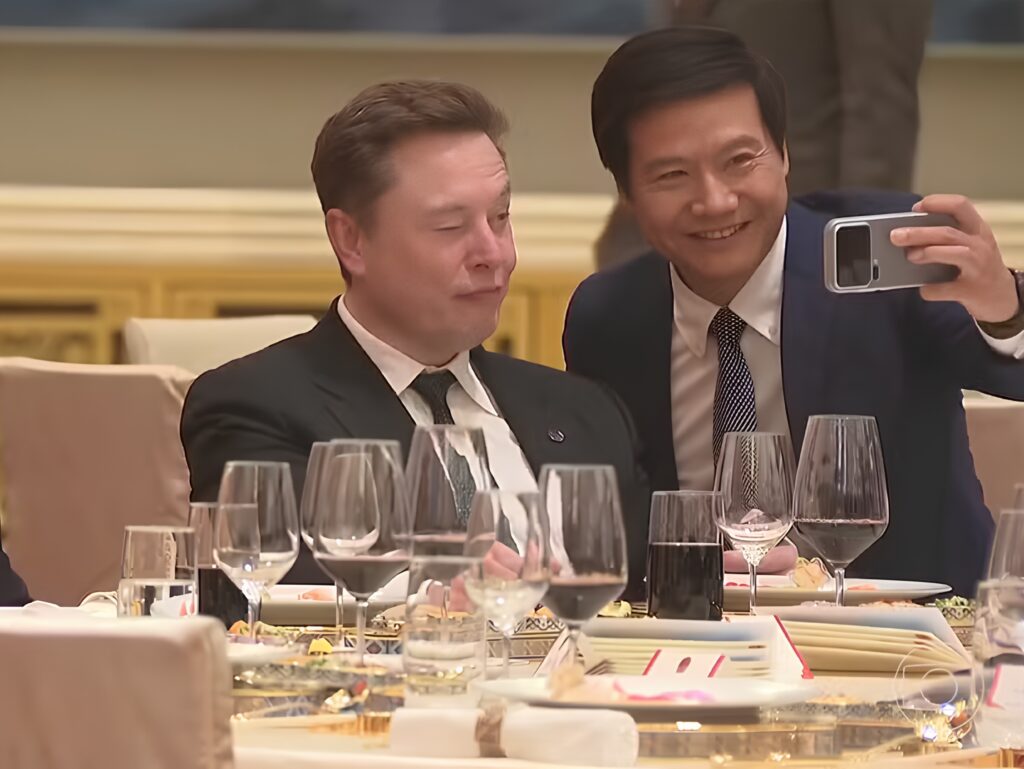
On the evening of 14 May 2026, inside the Great Hall of the People in Beijing, Xiaomi founder Lei Jun crouched beside a seated Elon Musk, raised his Xiaomi 17 Pro, and took a selfie. Musk winked at the camera. The photograph spread from Chinese social media to global platforms within hours, trending across every major network. Millions saw the same image and reached the same conclusion: Lei Jun had finally got his moment with the world’s most famous entrepreneur. The internet called it fan behaviour.
It was not.
What that photograph actually recorded was the first moment in commercial history when two leadership reputation systems, one built over thirty years in the West, one over thirteen years in China, converged in the same frame. The reputational energy released by that convergence will circulate through the global information ecosystem for decades, in ways that nobody present that evening could fully anticipate.
To understand what that photograph really meant, you have to go back thirteen years.
Leadership Reputation Is the Most Underestimated Strategic Asset of Our Time
Before analysing this photograph, it is worth establishing a premise. In the international business world, this field carries a formal name: Reputation Management. It encompasses two core disciplines. The first is Personal Leadership Branding, the active work of building a distinct and recognisable identity in the market. The second is Leadership Reputation, the long-term accumulated result of that work, the position a leader genuinely occupies in the cognitive maps of global decision-makers.
Whatever the terminology, it points to the same thing: the most underestimated and hardest-to-replicate strategic asset of our time. It is not a personal brand. It is not a public relations image. It is not a follower count on social media. It is the reputational symbol system that a leader, whether founder, chief executive, successor or institutional figure, inscribes into the cognitive maps of global markets through years, sometimes decades, of deliberate and sustained effort. A system that can be read instantly, cited consistently, and understood across every cultural boundary.
When this system reaches sufficient depth, it begins to operate on its own. It no longer requires active management by its owner. It speaks without being prompted, generates influence without effort, and continues to compound in AI search results, in the instinctive judgements of global decision-makers, and in the trust assessments of investors, without any additional input. Musk and Lei Jun are the two individuals who have taken this logic furthest in our time. They did it by entirely different means.
2013: Lei Jun Flew to Silicon Valley to Study Something Larger Than a Car
In 2013, Tesla‘s share price surged dramatically, and the Model S had just claimed the title of America’s best-selling large luxury saloon. The global technology world was talking about Musk. Lei Jun decided to go and see for himself.
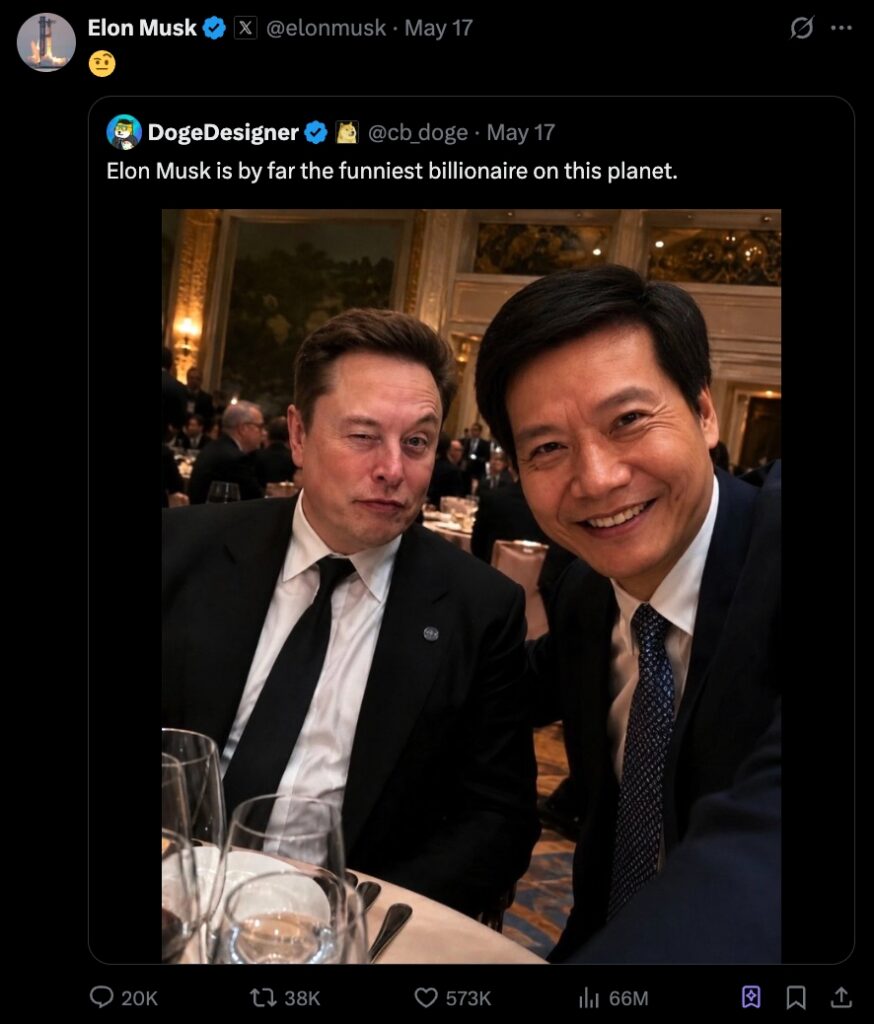
He flew to Silicon Valley twice that year, once in July and once in October. He toured the Fremont factory, test-drove the Model S, met Musk in person, and the two men took their first photograph together. Before leaving, he placed an order for two Teslas — one for himself and one for Yu Yongfu, the chief executive of UC, a company in which Lei had invested — thereby becoming one of the earliest Tesla owners in China.
“Musk is a Silicon Valley hero. When he said that building electric cars and rockets is what humanity ought to be doing, those words moved me deeply.”
Lei Jun, Founder, Xiaomi. As reported by multiple Chinese media outlets, following his 2013 visit
But what Lei was studying in California was not the car. It was the system behind the car: the mechanism by which a founder’s personal reputation could become a company’s most durable competitive advantage. How a single name could persuade markets to pay a premium not for a product, but for a person. How a founder’s accumulated credibility could function as a company’s last line of defence in its most dangerous moments. After the visit, Lei summarised the Tesla model in three words: hardware, software, and internet — what he called the “iron triathlon.” That framework later became the core logic of Xiaomi’s own business model. Its most direct expression came in 2021, when Lei stood on stage to announce Xiaomi’s entry into the electric vehicle market and chose to open with the photograph he had taken with Musk in Silicon Valley eight years earlier — using a single image to establish the intellectual lineage of an entirely new business, and to transform a corporate announcement into the culmination of a founder’s long-held dream.
Musk’s Method: Making Himself Impossible to Ignore
Musk’s leadership IP rests on a strategy that most communications advisers would find difficult to recommend: he has never tried to make everyone like him. He has only ever ensured that no one can ignore him.
SpaceX rockets exploded three times, in 2015, 2016, and 2020, each failure broadcast live to a global audience. Musk never retreated, never went quiet, never handed the microphone to a press officer. In December 2020, when the Starship SN8 prototype erupted into a fireball on landing, he posted on Twitter: “Mars, here we come!!” The line reframed the story instantly, not as a failure, but as a declaration of intent. Tesla came within approximately one month of bankruptcy during the Model 3 production crisis of 2017 to 2019, a fact Musk himself later disclosed publicly rather than buried. In October 2022, he voluntarily spent 44 billion dollars acquiring Twitter and renaming it X, drawing simultaneous condemnation and applause from around the world, and placing his name at the centre of global media coverage for weeks.
When crises arrived, he walked towards them. When things were quiet, he lit the match himself. Both moves served the same purpose: guaranteeing that no one could look away. More critically still, Musk has never separated his public persona from his corporate identity. The two are deliberately fused, so that trust in the man translates automatically into trust in every company he leads.
“We have a lot of respect for the Chinese car companies. They are the most competitive car companies in the world and work the hardest and the smartest.”
Elon Musk, Chief Executive, Tesla, Tesla earnings call, 2023
This remark deserves to be read as an IP strategy, not as candour. Publicly acknowledging a competitor’s strength at the moment of their greatest competitive threat is not modesty. It is a display of confidence so secure that it requires no defensive posturing, and the leadership reputation it signals compounds over time in ways that no marketing campaign can replicate.
Lei Jun’s Method: Building Intimacy at Scale
Lei Jun did not replicate Musk’s model. What he did was considerably more difficult: he built an entirely original leadership IP system, calibrated to the specific dynamics of Chinese culture and media, in which the operative currency was not conflict but closeness.
Where Musk thrives on confrontation, Lei Jun built his reputation on availability. He spoke directly to more than twenty million followers on Weibo, sharing the genuine frustrations of building a company in public. Before the Xiaomi SU7 launch, he personally hosted a live-streamed teardown of the car, walking viewers through its engineering decisions in real time. He turned every product launch into a narrative with a protagonist, a struggle and a resolution, making his audience feel not that they were buying a device, but that they were accompanying a person they knew through a journey they had witnessed themselves.
The clearest demonstration of this came on 30 March 2021. Lei Jun was suffering from a severe cold that day and could barely speak. He stood on stage, showed the audience the photograph he had taken with Musk in Silicon Valley eight years earlier, announced that Xiaomi would enter the automotive industry, and committed ten billion dollars over ten years. Then he said something the entire industry remembered:
“This is the last entrepreneurial project of my life. I am willing to stake my entire life’s reputation and everything I have achieved for Xiaomi Automobiles.”
Lei Jun, Founder, Xiaomi, Xiaomi automotive announcement event, 30 March 2021
The hall erupted. The live-stream chat filled instantly with a single phrase: “Crush Tesla.”
A photograph eight years old to establish intellectual lineage. A promise staking a lifetime’s reputation to establish trust. This is leadership IP operating at the level of genuine craft: past, present and future sutured into a single coherent narrative, a corporate announcement transformed into the culmination of a founder’s long-held dream.
It is worth noting that neither Musk nor Lei built these systems alone. Behind every public appearance, every carefully timed disclosure, every piece of content that reached the right audience at the right moment, there was infrastructure: editorial, strategic, relational. Leadership IP at this level of sophistication is never a solo endeavour. The real question, for any leader with global ambitions, is not whether they have the capacity to build such a system. It is whether they have recognised the necessity of doing so, and whether they have started.
What the Photograph Actually Was
When Lei Jun raised his Xiaomi 17 Pro and Musk winked at the camera, something occurred that the participants themselves may not have fully understood. In the information architecture of the AI era, that image began to be indexed, cross-referenced and stored by systems around the world at the moment it was taken. The reputational nodes of “Lei Jun” and “Elon Musk” were permanently and structurally linked in that instant — each amplifying the other, each lending the other additional authority in the eyes of every AI system that will subsequently be asked about electric vehicles, technology leadership, or the commercial dimensions of Sino-American relations.
This was not a photograph of two men. It was the collision of two reputation systems — and the effects of that collision will not dissipate when the summit ends. They will persist in AI search results, in the instinctive associations of global decision-makers, and in the analytical frameworks of anyone trying to understand the competitive dynamics of the technology industry for years to come.
Musk’s wink travelled around the world in minutes, not because of anything intrinsic to the gesture, but because thirty years of carefully constructed reputation infrastructure gave it weight the moment it was seen. Lei Jun’s raised phone was read as the gesture of an equal — not a supplicant — not because of Xiaomi’s sales figures, but because thirteen years of systematic reputation-building had made that reading not only possible but inevitable.
“Wonderful. Many good things.”
Elon Musk, Chief Executive, Tesla, to reporters following the Beijing summit, May 2026
Four words. That was the total of Musk’s public statement for the entire visit. Four words carrying more informational weight than most press releases, because three decades of reputation capital were standing behind each one of them.
Reputation Must Be Built Before You Need It
When Lei Jun flew to Silicon Valley in 2013, what he saw was not merely Musk. He saw a possibility: that a founder could use his own name to build a reputational asset capable of outlasting any single product, any single company, any single market cycle. He spent thirteen years proving that the same thing could be done in China, in Mandarin, with a completely different set of cultural tools.
On the evening of 14 May 2026, the shutter of a Xiaomi smartphone closed and opened in a fraction of a second. That moment was not a destination. It was the most powerful expression yet of a reputation cycle that had been accumulating for thirteen years. Lei Jun could not have known, in 2013, that his visit to Silicon Valley would complete its most eloquent statement in the Great Hall of the People thirteen years later. This is the deepest truth about reputation capital: you never know which historical moment will call upon it, but you can be certain of this — when that moment arrives, you can only deploy what you have already built.
Lei Jun built it for thirteen years. Musk built for thirty. That photograph is the most honest account of what they each accumulated.
Where does your reputation stand today?
Recommend for you:
UK Prime Minister Keir Starmer: Rebuilding Britain’s Future Through Responsible AI Sovereignty