


The rapid development of generative artificial intelligence is leading the global technology industry into a new era of computing. From Large Language Models (LLMs) to multimodal AI, model scale and computational power demands continue to rise. However, as technology begins its transition from research to commercial application, a new industry challenge is gradually emerging: computational power is not the only bottleneck. Memory costs, energy efficiency, and system architecture are progressively becoming critical constraints for AI implementation.
Against this backdrop, countries are beginning to seek new models of technological collaboration to accelerate the industrialization of AI and semiconductor research and development. Supported by Taiwan’s Ministry of Foreign Affairs (MOFA) and jointly promoted by the National Institutes of Applied Research (NIAR) and the Cybersecurity Hub CZ, theAdvanced Chip Design Research Center (ACDRC) Taiwan-Czech bilateral research program was born from these industrial needs and the trend in international technological cooperation. The program aims to establish a transnational semiconductor and AI technology cooperation platform by connecting Taiwanese enterprises, academic institutions, and Czech research units, attempting to advance research results into practical industrial applications.
Within the ACDRC program framework, a research team composed of Pedestal Inc. and National Taiwan University (NTU) has partnered with Brno University of Technology and the Czech Technical University in Prague. Their collaboration focuses on key issues such as large language model computing architectures and AI chip efficiency optimization, exploring how Taiwanese semiconductor technology can gradually enter the European market through transnational research cooperation.
In an exclusive interview with The Icons, a UK-based global entrepreneur media outlet, Pedestal Inc. CEO Kevin Hsu pointed out: “The real problem large language models encounter is actually memory and hardware costs.” He further explained, “When model parameters exceed 50 Billion, or even 100 Billion, the supply and price of DRAM become critical constraints.”
Against this industrial backdrop, Kevin Hsu and his team began to rethink the design direction of AI chips. By integrating the company’s technical capabilities, academic research, and transnational cooperation networks, Pedestal Inc. is attempting to find a new competitive path in the AI era, starting from the perspectives of computational efficiency and architectural innovation.
Kevin Hsu: What Enterprises Need for AI Adoption is Complete Technical Capability
At its inception, like most IC design companies, Pedestal Inc. originally aimed to launch its own chip products. However, during market engagement, Kevin Hsu and his team gradually discovered another need.
Many enterprises wished to integrate AI into their products but lacked chip design capabilities. On the other hand, directly adopting standard chips often made it difficult to meet their specific product requirements.
“Many companies want to adopt AI, but they don’t necessarily need a standard chip,” Kevin Hsu said. “What they need is a complete set of technical capabilities that enable AI implementation. To some extent, we are actually providing the entire design capability to our clients.”
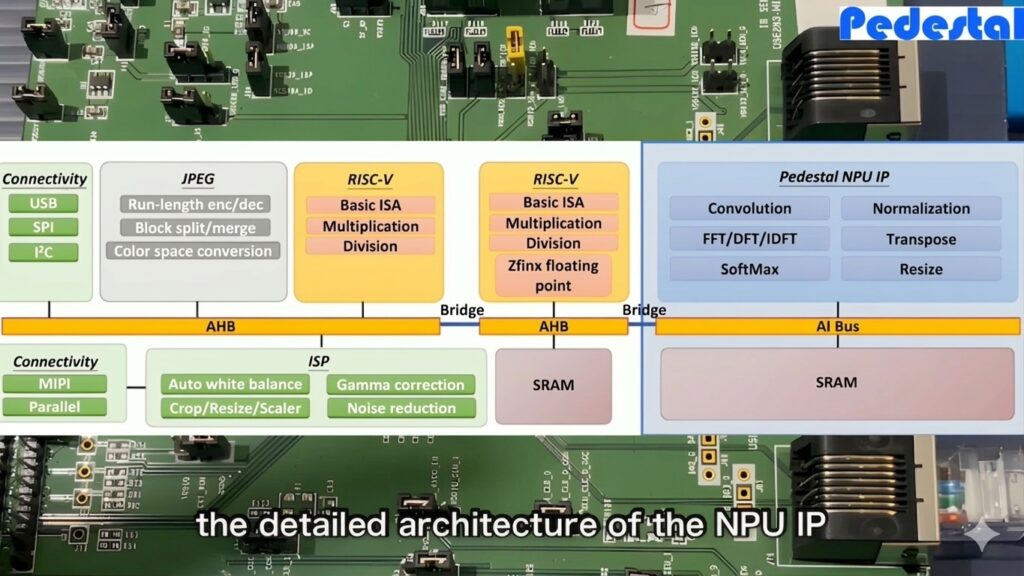
This observation ultimately led to the transformation of Pedestal Inc.’s business model. The company shifted from “making chips” to “providing NPU IP and integration services,” establishing a complete AI development toolchain that forms an integrated workflow from model design and compiler to hardware architecture.This strategy enables Pedestal Inc. to offer highly customized AI chip solutions to enterprises, allowing the company to establish a differentiated position in the fiercely competitive AI chip market.
AI Chip Design is Redefining Efficiency
In the past few years, the narrative of the AI chip industry has almost entirely revolved around the computational power race. However, for many enterprise products, what truly determines competitiveness is not maximum performance, but efficiency:
“Enterprise products ultimately have to return to power consumption and cost. If you can achieve half the power consumption of others under the same computational power, the entire product competitiveness becomes completely different.”
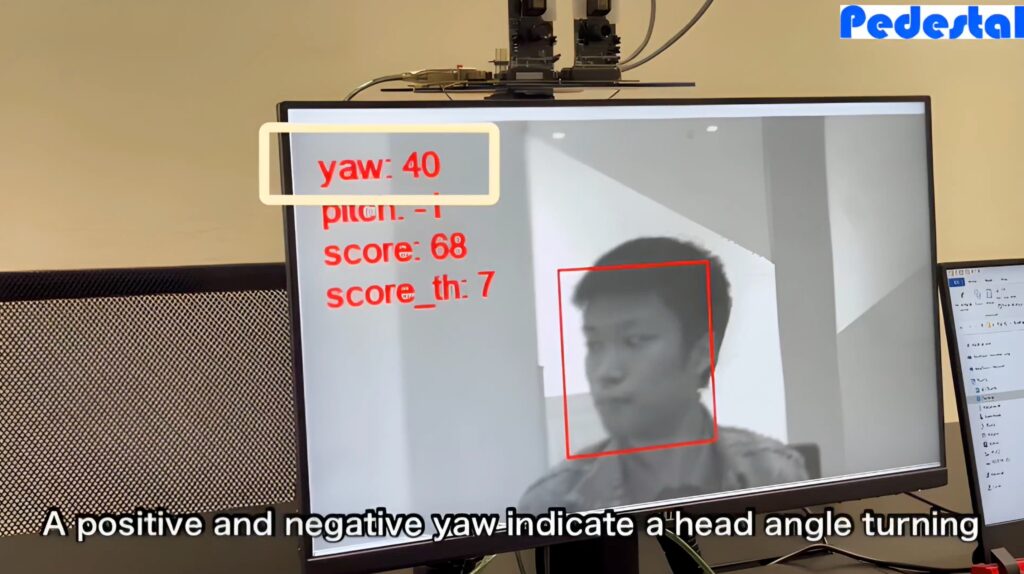
This difference is particularly evident in edge AI applications, such as laptops, tablets, or drones, where energy efficiency is often more critical than raw computational power. The Neural Processing Unit (NPU) designed by Pedestal Inc. has achieved approximately 30% lower power consumption compared to mainstream market solutions in some application scenarios.
Kevin Hsu points out that the next phase of AI competition will likely no longer be a simple GPU computational power race. “GPUs are designed for general-purpose computing, but a lot of AI inference actually involves fixed pattern computations. If you design from the architecture level, you can achieve higher efficiency at the hardware level.”
With this in mind, Pedestal Inc. chose to design its NPU around a DSP-centric architecture, gradually developing an AI computing framework focused on low-power inference.
Connecting European and Asian Semiconductor Ecosystems
With the advancement of AI and semiconductor technologies, international research collaboration is gradually becoming a significant force for industrial innovation. Pedestal Inc.’s participation in the ACDRC Taiwan-Czech bilateral research program involves collaborating with Czech academic institutions, allowing research resources and industrial needs to interface on a common platform.
This cooperation focuses on technological research and development while establishing a framework for transnational talent cultivation and industrial exchange.
Dr. Jiří Háze, director of the ACDRC center and head of the Department of Microelectronics at Brno University of Technology, pointed out that ACDRC is progressively becoming an important platform connecting the European and Asian semiconductor industries.
“ACDRC integrates research, education, and industrial cooperation within a single framework, enabling transnational collaboration to operate long-term. Through such cooperation mechanisms, Czech students can gain a clearer understanding of the complete semiconductor industry chain, while Taiwanese companies can access research-oriented system design capabilities.”
In his view, Taiwan and the Czech Republic possess high complementarity in semiconductor talent cultivation. Taiwan has a complete semiconductor industry chain, allowing students to encounter the practical industrial environment early on. Czech engineering education emphasizes theoretical foundations and system design capabilities.
From Academic Research to Market Application: A New Model for Transnational Cooperation
For enterprises, the value of international research collaboration is often reflected in the connection between research results and industrial application. Through transnational cooperation mechanisms, companies can access the technological needs of different markets earlier, aligning research and development directions more closely with actual industrial scenarios.
Kevin Hsu noted that through collaboration with Czech universities, Pedestal Inc. has been able to access new industrial demands. For instance, in the European market, the importance of automotive electronics and industrial applications far exceeds that in the Asian market:
“The demand for automotive chips in the Czech market is very pronounced. This is an application area we have had less exposure to in the past.”
Dr. Jiří Jakovenko, ACDRC Executive Board Member and Vice-Dean of the Faculty of Electrical Engineering at the Czech Technical University in Prague, pointed out that ACDRC is designed precisely to make research results more accessible to industry.
“The most effective cooperation model is one where education, research, and industrial needs coexist,” said Jiří Jakovenko. “Through co-supervising graduate students, enterprise participation in research projects, and long-term internship systems, research results can enter the market more quickly.”
This collaborative framework is gradually transforming the exchanges between Taiwan and the Czech Republic from one-off research cooperation into a continuously operating transnational technology and talent network.
Redefining Roles in the Global AI Race
As generative artificial intelligence transitions from technological breakthroughs towards industrial application, the competitive logic of the semiconductor industry is also changing. In recent years, market focus has often centered on model scale and computational power metrics. However, as AI technology begins to enter practical product scenarios, the importance of chip architecture and energy efficiency is rapidly increasing.
In Kevin Hsu’s observation, the AI chip industry is likely approaching a new round of elimination. As more and more companies invest in AI accelerator development, the clarity of the technological roadmap will directly determine whether a company can survive the next phase of competition.
“In the end, the companies that remain will be those with very clear technological differentiation.” For Pedestal Inc., this roadmap has always revolved around the same core principle: low-power AI inference. The team designs computation units based on a DSP architecture and continuously optimizes data flow and system integration, aiming to establish a chip platform with superior efficiency advantages in edge computing and embedded devices.
Discussing the future technical direction of their products, Kevin Hsu provided a clear goal: “Our target is to launch the world’s lowest power AI inference chip within three to five years.” In his view, as AI technology gradually enters more terminal devices and application scenarios, the balance between power consumption and performance will become a crucial condition for product competitiveness. For Pedestal Inc., low power is not just a technical metric, but a design philosophy that determines whether a product can truly be adopted by the market.
Amidst these industrial changes, the research collaboration extending from Taiwan to the Czech Republic and Europe also provides new pathways for technological development. Through the transnational research platform established by ACDRC, enterprises, academia, and research institutions can promote technological research and development and application validation under a common framework, enabling research results to enter practical industrial scenarios more quickly:”Future competition in AI will not just be a battle of model parameters, but a contest of overall computational efficiency. Whoever can utilize computational power to its fullest extent under limited energy and hardware conditions will have a better chance of securing their position in this wave of the AI industry revolution.”
Recommend for you: