


TM Forum’s Aaron Boasman-Patel on the limits of machine autonomy, the trust gap in telecoms and why governance is becoming a business capability.
The question has changed from what AI knows to what it may do
A system that produces a wrong answer is a familiar problem. A system that acts on that answer—accessing software, changing workflows or interacting with customers—raises a more consequential question: who authorised the action, and who remains responsible when it goes wrong? For Aaron Boasman-Patel, Vice President, Knowledge & Innovation at TM Forum, this is the leadership problem emerging as businesses move from AI adoption towards AI autonomy.
“The fundamental change is that AI is moving from generating an answer to taking an action,”
he told The Icons in a written interview. An agent can call tools, communicate with other agents and pursue an objective across systems. Its intelligence matters, but so do the boundaries of its authority. The issue is no longer just whether an output is correct; it is what a machine is permitted to do with that output.
Boasman-Patel argues that human oversight cannot consist of approving every interaction. Thousands of events may unfold at machine speed, making manual sign-off an inadequate control mechanism. Instead, organisations have to distinguish between an agent recommending a course of action and one changing the configuration of critical infrastructure. Permissions must be identifiable and revocable, with automated restrictions that can actually be enforced. People still set objectives, determine limits, handle exceptions and retain the power to intervene.
“More autonomy should not mean less human authority. It should mean exercising that authority differently,”
he said.
The gap between confidence and proof
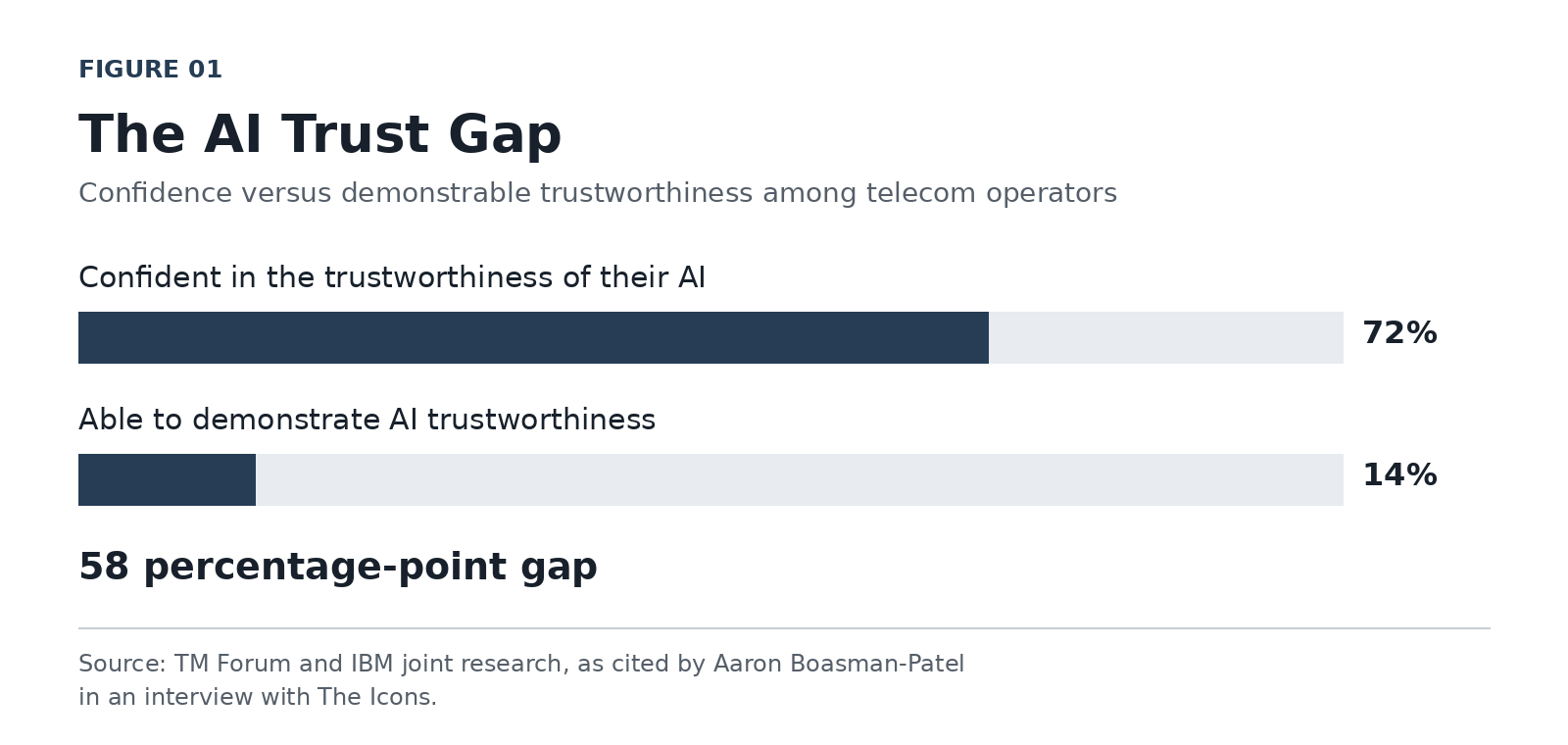
That distinction exposes a problem in the way businesses talk about trustworthy AI. In TM Forum research conducted with IBM, as cited by Boasman-Patel, 72% of telecom operators expressed confidence that their AI was trustworthy, while just 14% could demonstrate that trustworthiness. The difference is 58 percentage points—not a measure of how often AI fails, but a striking separation between belief and evidence.
For him, trust does not mean a model will never make a mistake. It means an organisation knows under what conditions an agent operates, can identify it, revoke its access, attribute its actions and reconstruct what happened. A policy restricting access is useful only if that restriction is enforced while the system is running. Governance, in this conception, belongs inside the operating environment rather than in a document consulted after an incident.
“Trust ultimately comes from being able to prove that autonomy is operating within defined limits,”
he said. Accountability also cannot end with the agent. Model developers, platforms and suppliers may all participate in a decision chain, but the organisation choosing to delegate authority must establish ownership and decision rights before deployment. Complexity is not a defence against responsibility.
Asia’s networks put autonomy to a practical test
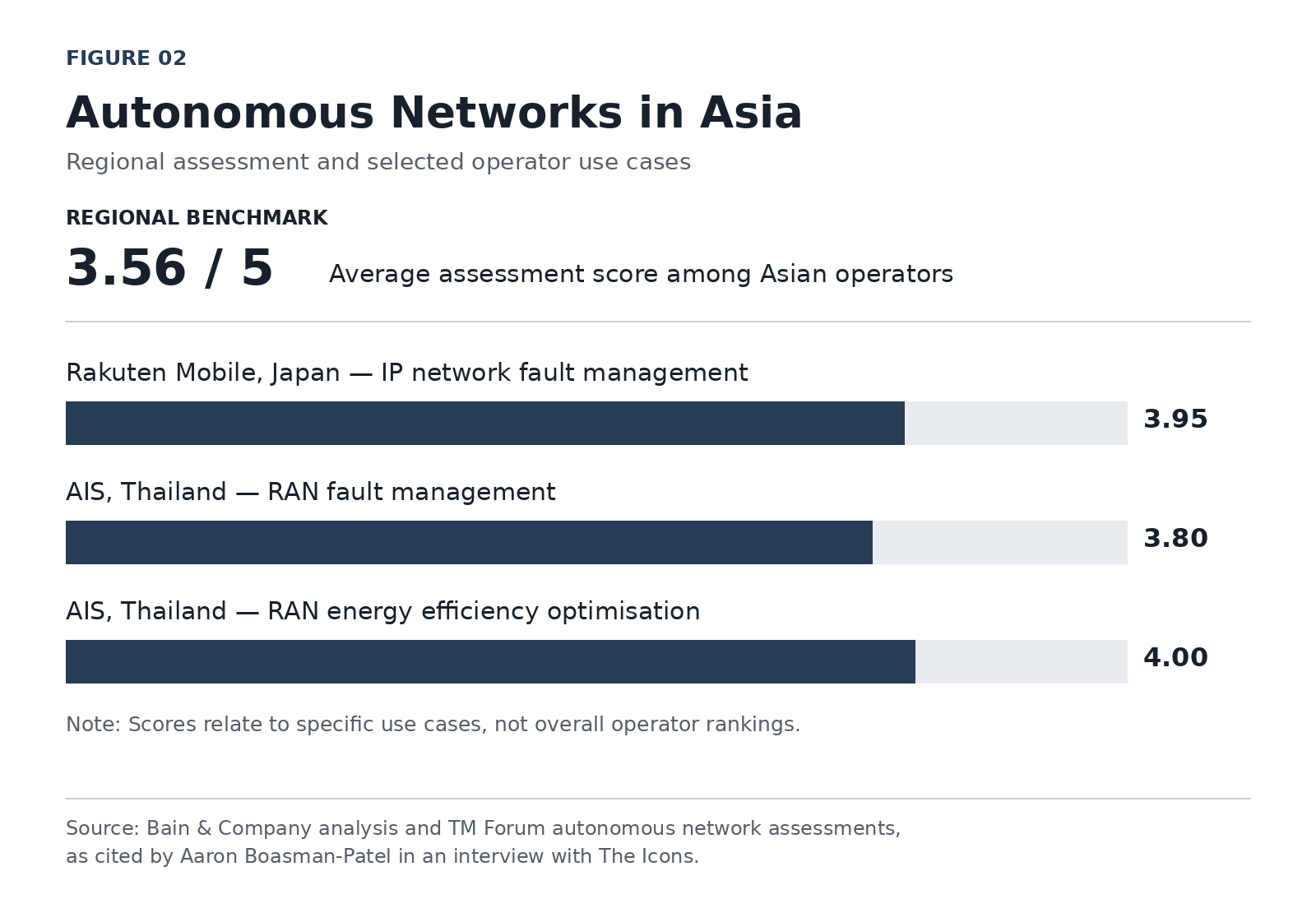
Telecommunications offers a particularly useful proving ground: networks are interconnected, service failures are visible, and resilience can be measured. According to Boasman-Patel, many operators globally begin at about Level 2 in TM Forum’s Autonomous Network Levels framework. He cites Bain & Company analysis putting Asian operators at an average assessment score of 3.56, the highest regional average among those assessed. That figure is a regional assessment, not a claim that every Asian network has reached the same level.
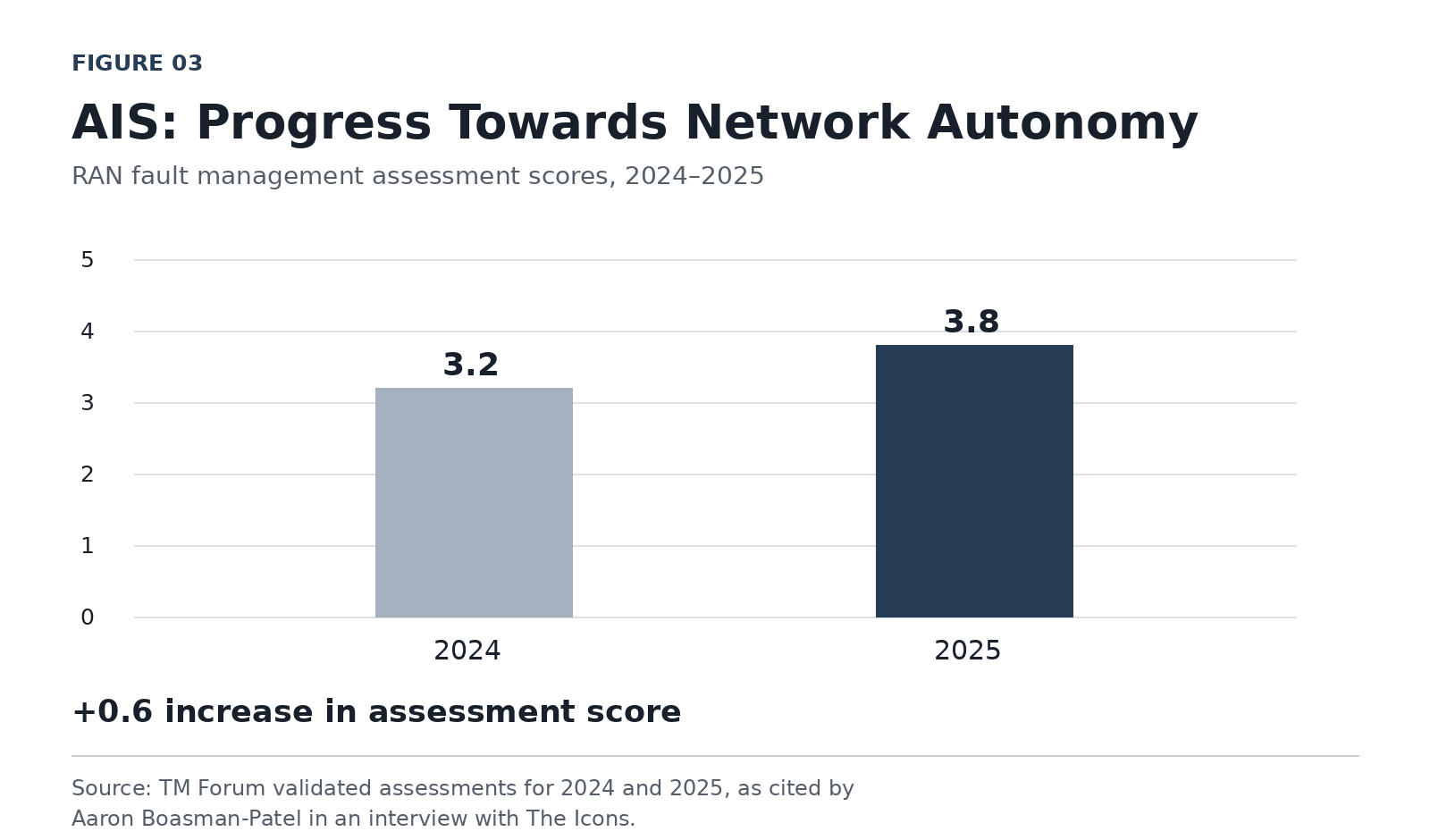
Specific use cases reveal what greater autonomy looks like. In Japan, Rakuten Mobile received a validated assessment of 3.95 for IP network fault management, according to the interview. Its live commercial system can detect and analyse faults, decide on a response, carry out remediation and check recovery without routine human intervention. In Thailand, AIS advanced from 3.2 in 2024 to 3.8 in 2025 in validated RAN fault-management assessments, and recorded 4.0 in RAN energy-efficiency optimisation. These scores refer to defined network functions; they are not all-purpose league-table positions for the companies.
The significance is in the sequence. Operators can specify a particular operational task, measure its outcome and extend the system’s remit when the evidence warrants it. “Autonomy does not arrive in one leap,”
Boasman-Patel said. More authority is earned through repeatable performance, not granted because the technology looks impressive in a demonstration.
A lesson for every industry that delegates a decision
Finance, healthcare and manufacturing may have different regulatory and operational demands, but the principle transfers. Boasman-Patel compares an AI agent to a new employee: competence alone is no reason to hand over unrestricted access to critical systems. An organisation assigns an identity, a role, permissions and approval limits, then holds the person accountable. Machine agents require equivalent discipline.
This approach turns governance from a presumed obstacle into a condition for scaling. When a business knows exactly which systems an agent may enter, what decisions it may take and how outcomes are monitored, it can delegate with greater confidence. When those questions remain unresolved, adding agents may increase exposure rather than capability. “I don’t see governance as the brake on innovation. Done properly, it is what allows organisations to move faster,”
he said.
In five years, he suggests, the hallmark of an AI-native organisation will not be the number of agents it runs. It will be whether their actions are observable and auditable, permissions are explicit, and humans remain responsible for objectives, exceptions and the decision to extend autonomy. His advice to leaders is to settle the rights of decision before the systems scale: what may happen without approval, what requires it, and what must never happen at all.
The competitive test is therefore not simply who has the most capable model. It is who can give capable systems meaningful work without surrendering control. As Boasman-Patel put it: “Capability and control have to advance together.”
Editor’s Picks
Asia’s Race to Autonomous Networks Takes Centre Stage at Innovate Asia 2026